Orion Corporate
“For Futures Yet to Come.”
— Words of the Corporate
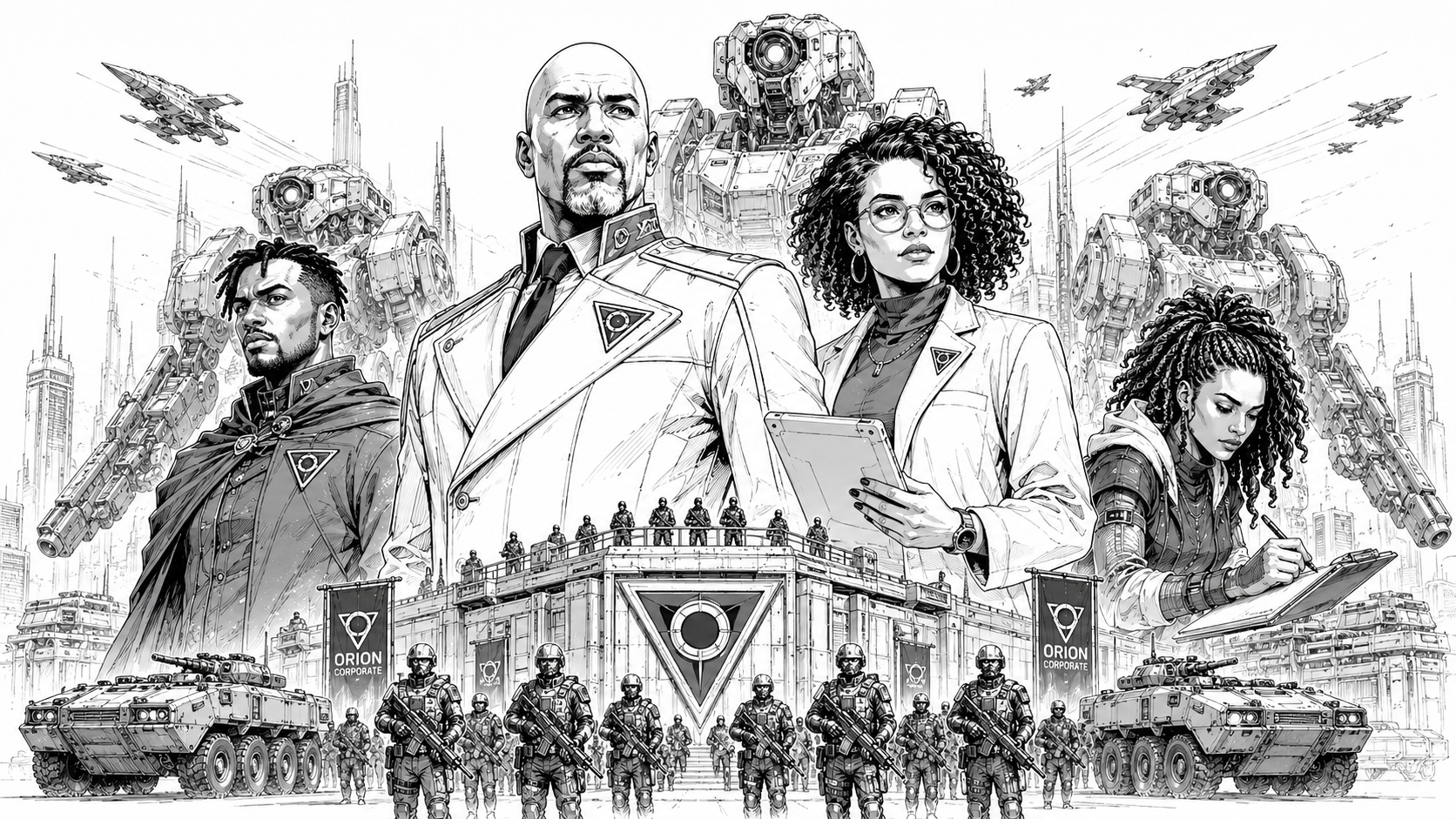 Corporate propaganda illustration depicting Prodirector Deckard Noddack standing at the center of the Orion Corporate Directorate alongside his wife, Dr. Alise Noddack (right), Zyce Noddack-Voss (left) head of the Corporate Internal Security Forces, and Celeste Noddack (far right) the daughter and heir of the Corporate. Behind them loom the sleek cyclopean mechs of the Orion Corporate, their glowing mono-eye sensors watching over the technological heart of the Core.
Overview
| Government Type | Corporate-Technocratic Alliance |
| Capital World | Horizon's Reach |
| Founding Structure | The Three Pillars |
| Population | 13.4 billion |
| Primary Strength | Technology and Scientific Advancement |
| Military Specialty | Advanced Electronics and Precision Warfare |
| National Motto | “For Futures Yet To Come.” |
Orion Corporate is one of the five Great Houses of the Core and the foremost technological power in known space. Ruled by House Noddack from the world of Horizon's Reach, the Corporate traces its origins not to ancient dynasties or military conquest, but to a coalition of survivors who endured the dark age through science, cooperation, and long-term planning.
Where other powers often look to the past for guidance, the Corporate focuses relentlessly upon the future. Its universities educate the brightest minds in the Core, its laboratories produce a constant stream of innovation, and its industrial infrastructure powers much of modern civilization. Across countless worlds, Corporate engineers, scientists, and administrators work toward a singular goal: ensuring that humanity never again suffers the collapse that nearly destroyed it.
Supporters regard the Corporate as humanity's greatest engine of progress and innovation. Critics accuse it of technocratic arrogance and an excessive faith in planning, efficiency, and expertise. Yet even its rivals acknowledge that few institutions have contributed more to the advancement of modern civilization.
The Corporate's words, "For Futures Yet To Come," reflect a philosophy that permeates nearly every aspect of Orion society: that each generation bears a responsibility to leave the future better than it found it.
History
The origins of Orion Corporate lie in the chaos that followed the Collapse. As interstellar civilization fragmented and countless worlds descended into isolation, piracy, and economic ruin, three surviving colonies chose a different path. Rather than retreating behind their own borders, they formed a defensive and economic alliance dedicated to preserving knowledge, industry, and social stability.
This alliance eventually became known as the Three Pillars.
The experience profoundly shaped the Corporate's worldview. While many surviving powers concluded that strength, tradition, or military authority were the keys to survival, the founders of the Corporate reached a different conclusion. They believed civilization had nearly perished because humanity had failed to cooperate, failed to preserve knowledge, and failed to plan for the future.
As the dark age continued, the Three Pillars gradually expanded their influence through technological expertise, industrial production, and coordinated development. Their worlds became islands of stability in an increasingly dangerous galaxy. New colonies joined the alliance, institutions grew more sophisticated, and the Corporate steadily evolved into one of the most advanced powers in human space.
By the time the Great Restoration began, the Corporate was already among the few multi-world civilizations to have survived the dark age largely intact. The lessons learned during that era continue to shape Corporate policy today. To Corporate leaders, technological progress is not merely desirable—it is civilization's best defense against repeating the mistakes of the past.
The Three Pillars
The foundation of modern Orion Corporate can be traced to an alliance known as the Three Pillars.
During the dark age, as much of interstellar civilization fragmented into isolation, piracy, and warfare, three surviving colonies formed a defensive pact to ensure their mutual survival. In the language of the Core, such an alliance was known as a corporate—a formal agreement through which multiple worlds pooled resources, coordinated defense, and shared responsibility for their collective future.
Rather than relying solely upon military strength, the Three Pillars invested heavily in scientific research, engineering, industrial production, and technological development. Their leaders believed that knowledge and cooperation offered a more sustainable path to survival than conquest or isolation. Through shared resources, coordinated planning, and advanced technology, the alliance gradually transformed three vulnerable colonies into one of the most stable regions of human space.
As surrounding worlds descended into decline, the Three Pillars became a beacon of security and prosperity amid the chaos of the dark age. Over time, the alliance expanded, incorporating new territories and institutions until it eventually evolved into the modern Orion Corporate.
Even today, the Three Pillars remain central to Corporate identity. The Corporate continues to view cooperation, scientific advancement, and long-term planning as the foundations upon which civilization itself rests.
The Great Restoration
When House Caledon and the Vanguard forces returned during the Great Restoration, Orion Corporate was already one of the few functioning multi-world powers remaining in the Core.
The returning Regency relied heavily upon Orion technological infrastructure and engineering expertise during the reconstruction of civilization.
Through close cooperation with the Regency, Orion gained major political legitimacy and increasing territorial responsibility throughout the recovering Core.
Many historians believe the Restoration could not have succeeded as rapidly without Orion support.
Government
The Orion Corporate is governed through a hybrid system that combines local autonomy with centralized coordination. Unlike most Great Houses, which concentrate authority within a ruling dynasty or military hierarchy, the Corporate traces its origins to an alliance of independent worlds that voluntarily united for mutual survival during the dark age.
This legacy remains visible in its modern government. Each major member world maintains representation within the Corporate Council, a legislative body responsible for setting policy, coordinating large-scale initiatives, and resolving disputes between member systems. The council functions similarly to a parliamentary assembly, with representatives balancing local interests against the broader needs of the Corporate as a whole.
As the Corporate expanded and governing a growing interstellar civilization became increasingly complex, a centralized executive office emerged to coordinate policy and provide long-term strategic leadership. This office eventually became associated with House Noddack, whose members have guided the Corporate for generations. While the Prodirector possesses significant authority, the position functions more as a chief executive and coordinator than as an absolute ruler.
The result is one of the most decentralized governments among the Great Houses. Individual worlds retain substantial authority over local administration, economic policy, infrastructure, and internal affairs. Supporters argue that this system encourages innovation, flexibility, and local accountability. Critics contend that it can slow decision-making and make the Corporate less responsive during major crises.
To Corporate citizens, however, this balance between local autonomy and centralized coordination reflects one of the state's founding principles: that cooperation produces stronger outcomes than domination.
House Noddack
The Orion Corporate is ruled by House Noddack, a family whose influence spans science, governance, military planning, and industrial administration. Unlike many noble houses of the Core, House Noddack derives its prestige less from military conquest or ancient bloodlines and more from generations of scientific achievement and public service.
The current ruler, Prodirector Deckard Noddack, is both a statesman and an accomplished scientist. Reserved, analytical, and intensely forward-thinking, Deckard is known for treating governance as a problem to be solved rather than a stage upon which to perform. He remains actively involved in many of the Corporate's largest scientific and industrial initiatives, believing that leaders should understand the technologies shaping the future rather than merely oversee them.
His wife, Dr. Elise Noddack, is one of the most respected mathematicians in the Core. Equally comfortable advising government committees or lecturing at Central Academy, Elise embodies the Corporate ideal that scholarship and public service should exist side by side.
Their daughter and heir, Celeste Noddack, has already earned a reputation as a prodigy within Corporate academic circles. Brilliant, ambitious, and intensely driven, she possesses an almost relentless desire to prove herself worthy of both her family name and the future leadership of the Corporate.
The administrative machinery of Orion is overseen in large part by Zysce Noddack-Voss, Deckard's cousin and one of the most influential political figures within the state. In addition to managing much of the Corporate bureaucracy, Zysce directs internal security and counter-espionage operations. Their efforts help protect Orion's research institutions, technological secrets, and scientific infrastructure from rivals throughout the Core.
Together, House Noddack represents the values upon which Orion was founded: knowledge, competence, innovation, and responsibility to future generations.
The Future Doctrine
More than any other Great House, Orion Corporate thinks in decades rather than years.
Corporate planners frequently pursue projects whose benefits may not be realized for generations. Infrastructure, research programs, colonization initiatives, educational systems, and technological development are often evaluated according to their long-term contribution to civilization rather than their immediate political value.
This philosophy is embodied by the Corporate's words:
"For Futures Yet To Come."
To Corporate citizens, the phrase is more than a slogan. It reflects the belief that every generation inherits a responsibility to improve the world for those who follow. Decisions are therefore judged not only by their present consequences, but by the future they help create.
This perspective frequently places the Corporate at odds with other powers. Critics accuse the Corporate of arrogance and excessive faith in planning. Supporters argue that civilization survives only when someone is willing to think beyond the next election, the next crisis, or the next war.
Horizon's Reach
Horizon's Reach is the capital world of the Orion Corporate and among the most technologically sophisticated planets in human space. Vast research arcologies, automated manufacturing districts, orbital shipyards, and sprawling university complexes dominate the landscape, creating a world that often feels more like a living laboratory than a traditional capital.
Unlike the grand palaces of the Imperium or the luxurious estates of the Sovereignty, Horizon's Reach was designed around function, efficiency, and innovation. Much of the planet's surface is dedicated to research institutions, industrial infrastructure, educational centers, and scientific development. Entire districts are devoted to experimental technologies that may not become commercially viable for decades.
The world attracts scientists, engineers, entrepreneurs, and scholars from across the Core. To many, Horizon's Reach represents humanity's future. To others, it serves as a warning about what civilization becomes when efficiency begins to replace tradition.
Society and Culture
Orion society prizes knowledge, innovation, competence, and achievement. From an early age, citizens are encouraged to pursue education and develop expertise in whatever fields best suit their talents. Academic success, scientific accomplishment, and technical skill carry enormous social prestige throughout the Corporate.
Unlike many of the aristocratic powers of the Core, Orion places relatively little emphasis on bloodline, heritage, or social standing. Advancement is expected to be earned through performance rather than inherited through family connections. While reality does not always perfectly match this ideal, the belief remains central to Corporate identity.
This meritocratic culture has produced some of the finest engineers, scientists, mathematicians, physicians, and researchers in known space. It has also fostered an intensely competitive environment in which excellence is expected and mediocrity is rarely tolerated.
Many outsiders perceive Corporate citizens as highly intelligent but emotionally reserved. Corporate citizens often counter that they simply prefer solutions to rhetoric, evidence to tradition, and results to appearances.
Technology and Research
Orion Corporate is widely regarded as the technological heart of the Core. Its universities, laboratories, industrial complexes, and research institutes produce a constant stream of innovations that influence nearly every aspect of modern civilization.
Many technologies now considered commonplace throughout the Core were originally developed or refined by Corporate scientists, including advances in computing, automation, reactor engineering, battlefield networking, sensors, communications, and industrial manufacturing.
The Corporate's commitment to scientific advancement stems directly from its experiences during the Collapse. Witnessing the near-loss of humanity's accumulated knowledge convinced Orion's founders that technological stagnation represented one of the greatest threats to civilization itself. As a result, research and education remain among the highest priorities of the modern Corporate.
Unlike many powers that focus primarily on immediate concerns, Orion frequently invests in projects whose benefits may not be realized for decades. To Corporate planners, technological progress is not simply a tool for gaining power—it is a responsibility owed to future generations.
The Lost Research Centers
Among Orion's most prized possessions are several surviving research complexes dating back to the Golden Empire.
Though the facilities themselves are no longer operational and much of their original technology has been lost to history, they remain among the most important historical sites within the Corporate. Scientists, historians, and engineers from across the Core travel to study these ancient monuments in hopes of uncovering fragments of forgotten knowledge.
Beyond their practical value, the centers possess immense symbolic significance. To Corporate citizens, they serve as reminders of both humanity's greatest achievements and the consequences of allowing civilization to decline. Many regard them as sacred institutions dedicated to preserving humanity's intellectual heritage.
The existence of these facilities has further strengthened Orion's reputation as the foremost center of science, education, and technological scholarship within the Core.
Exploration Beyond the Core
While most Great Houses remain focused upon the politics and rivalries of the Core, Orion Corporate maintains a growing interest in regions beyond known space.
Corporate leaders view exploration as both a scientific endeavor and a long-term strategic necessity. To them, the future of humanity cannot remain permanently confined within the borders of the Core. New resources, technologies, discoveries, and opportunities may await beyond the frontier.
As a result, the Corporate maintains the largest exploration and survey programs of any Great House. Corporate expeditions regularly venture into the Fringe, mapping unknown systems, investigating ancient ruins, and establishing isolated outposts far beyond traditional borders.
Critics frequently dismiss these efforts as expensive distractions. Corporate researchers counter that every great civilization eventually stagnates if it ceases to explore.
In many ways, Orion's frontier initiatives represent the purest expression of its guiding philosophy: preparing humanity for futures yet to come.
Military
The Orion Corporate fields one of the most technologically advanced militaries in the Core. While other Great Houses often emphasize brute force, overwhelming numbers, or individual heroics, the Corporate approaches warfare as an engineering problem to be solved through information, coordination, and precision.
Corporate commanders seek to understand the battlefield before committing to it. Reconnaissance networks, sensor arrays, battlefield simulations, and predictive analytics are employed extensively to identify weaknesses and exploit them with minimal losses. Corporate officers are trained to view unnecessary casualties as failures of planning rather than unavoidable costs of war.
This philosophy has produced a military that excels at coordinated operations, long-range engagements, electronic warfare, and battlefield control. Corporate formations are often capable of sharing targeting data, sensor information, and tactical updates across an entire combat theater, allowing units to react with remarkable speed and efficiency.
The Corporate's decentralized political structure is also reflected in its military organization. Unlike most Great Houses, whose armed forces answer directly to a centralized authority, much of the Corporate's military strength remains distributed among planetary governments, regional magistrates, and local administrative authorities. While these forces are formally part of the larger Corporate military command, local leaders retain significant influence over their deployment and operations. As a result, assembling large expeditionary armies often requires the cooperation and approval of numerous political stakeholders. Supporters argue that this system prevents the concentration of military power in any single set of hands and encourages local accountability. Critics counter that it can slow mobilization efforts and complicate strategic decision-making during rapidly evolving crises.
The Corporate's military strength is not without weaknesses. Corporate officers are frequently selected for their intelligence, education, and technical expertise, sometimes at the expense of intuition or battlefield aggression. Critics argue that Corporate commanders can become overly reliant upon planning and simulation, occasionally struggling when confronted with unpredictable opponents who refuse to behave as expected.
Nevertheless, few powers can match the Orion Corporate's ability to integrate technology, information, and firepower into a single coordinated fighting force.
Shield Matrix Systems
The Orion Corporate is the only power in the Core to field Shield Matrix technology on a large scale.
Shield Matrix systems generate powerful electromagnetic energy barriers through specialized coil assemblies integrated directly into a mech's frame. These barriers are capable of disrupting missiles, rockets, laser fire, and High Energy Cannon attacks before they can damage the mech itself.
Perhaps most remarkably, Shield Matrix systems gradually regenerate over time, allowing Corporate mechs to recover from damage during extended engagements. This gives Orion forces an unusual degree of battlefield endurance despite often fielding lighter armored designs than many of their rivals.
The technology is not without weaknesses. Sustained fire can overwhelm a shield faster than it can regenerate, and ballistic weapons such as Autoguns, Cannons, MAC Guns, and certain heat-based weapons largely bypass its protective effects. As a result, Orion commanders must carefully manage their shields and avoid situations where enemies can exploit these vulnerabilities.
Despite these limitations, the Shield Matrix remains one of the most significant defensive innovations in modern warfare.
Prismatic Lasers
Prismatic Lasers are the signature weapon system of Orion Corporate and among the most sophisticated energy weapons ever developed.
Unlike conventional laser systems, Prismatic Lasers utilize advanced focusing arrays and battlefield simulation computers to deliberately ricochet beams between multiple targets. Through precise calculations performed in real time, a single shot can strike two, three, or even more nearby enemy units in rapid succession.
The system is especially effective against tightly grouped formations, where reflected beams can inflict devastating damage across an entire battle line. Opposing commanders frequently attempt to counter Prismatic Lasers by dispersing their forces, though battlefield conditions do not always permit such spacing.
Corporate targeting computers continuously model the battlefield, calculating reflection angles and target priorities faster than any human operator could manage alone. The result is a weapon system capable of producing battlefield effects that many observers initially mistake for advanced automation or artificial intelligence.
Throughout the Core, Prismatic Lasers have become synonymous with Orion's approach to warfare: technologically elegant, mathematically precise, and devastatingly effective when employed under the proper conditions.
Politics and Foreign Relations
Orion Corporate maintains relationships with every major power in the Core, though its emphasis on technology, meritocracy, and scientific progress often places it at odds with more traditional societies.
Its most strained relationship is with the Omnisphere Imperium. While the Imperium views history and tradition as the foundation of civilization, the Corporate places its faith in innovation and adaptation. Imperial traditionalists frequently criticize the Corporate as culturally sterile and excessively dependent upon technology. Corporate citizens often respond that progress is impossible without a willingness to challenge old assumptions.
Relations with the Sovereignty are generally positive. Both powers share interests in administration, economics, education, and long-term planning, though competition between the two remains substantial. Many of the Core's largest technological and economic initiatives involve cooperation between Orion and Helios institutions.
The Confederate Vanguard Union views Orion with a mixture of respect and suspicion. Union leaders admire the Corporate's industrial capabilities but remain wary of its technological advantages and growing political influence. The Corporate, in turn, often regards the Union as overly focused on military solutions to problems better solved through diplomacy, economics, or technological development.
Relations with the Starcrest Protectorate are generally cordial. While the two powers possess very different cultures, both share a practical approach to governance and a strong sense of responsibility toward the long-term stability of civilization.
Throughout the Core, the Corporate is often regarded as both a partner and a competitor. Many governments depend upon Corporate technology, expertise, and infrastructure even while remaining wary of its growing influence.
Mercenary Relations
Orion Corporate employs a contract structure unlike any other Great House.
Where most powers offer modest advances and substantial completion bonuses, Orion frequently reverses the arrangement. Mercenary companies are often provided with generous upfront payments, while mission completion rewards tend to be comparatively modest.
Corporate contracts also place unusual emphasis on measurable battlefield results. Rather than rewarding success solely through mission completion, Orion commonly supplements payment with bounties for confirmed battlefield kills and destroyed enemy assets. During large-scale conflicts this system can prove extraordinarily profitable, while smaller operations often generate more modest returns.
The Corporate is generally regarded as fair, predictable, and professional in its dealings. However, it possesses little tolerance for companies that abandon contracts or fail to fulfill their obligations. Mercenary units that betray Corporate trust frequently find themselves blacklisted from future employment and shut out of valuable business opportunities throughout Orion space.
As a result, veteran mercenaries often describe Orion contracts as some of the safest and most predictable in the Core—provided one intends to honor the agreement.
"Don't piss off the Corporate." — Common mercenary warning
Modern Outlook
As instability spreads throughout the Core and tensions between the Great Houses continue to rise, Orion Corporate increasingly argues that humanity stands at a crossroads. To Corporate leaders, the greatest threats facing civilization are not merely military rivals or political disputes, but stagnation, complacency, and the loss of knowledge.
Many within the Corporate believe the lessons of the Collapse have been forgotten. They warn that civilizations do not fall suddenly, but gradually, through the accumulation of neglected problems, declining institutions, and a failure to prepare for future challenges. For this reason, the Corporate continues investing heavily in scientific research, industrial development, education, exploration, and military innovation.
Whether these efforts ultimately secure humanity's future remains an open question. Supporters see the Corporate as the architect of a brighter age of discovery and progress. Critics fear that its growing influence may produce a society increasingly governed by experts, algorithms, and institutions rather than people.
To Orion, however, the answer remains simple. The future is not something to be awaited. It is something to be built.