Helios Sovereignty
“Strength wins battles. Wealth wins wars.”
— Arthur Payne
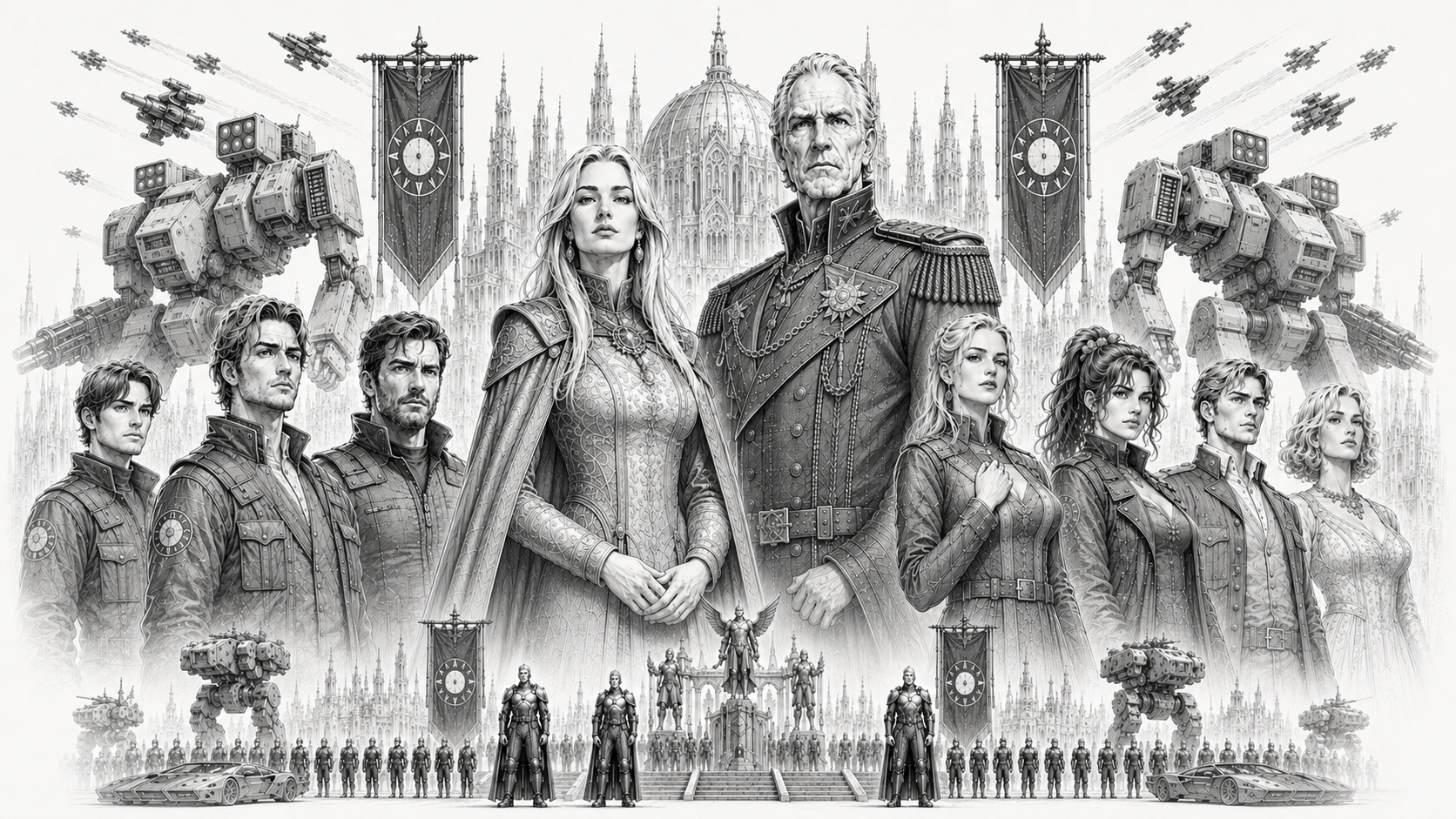 Archon Alissa Aerin and Lord Arthur Payne standing united at the center of the Helios Sovereignty, surrounded by the heirs and bloodlines of Houses Aerin and Payne. From left to right stand Archer Payne, Torrin Payne, Alexander Payne, Alissa Aerin, Arthur Payne, Elara Aerin, Lex Aerin, Ravin Aerin, and Aurora Aerin, with the towering war machines of the Sovereignty looming behind them.
Overview
| Government Type | Aristocratic Sovereignty |
| Ruling Houses | House Aerin and House Payne |
| Capital World | Lumina |
| Population | 11.7 billion |
| Primary Strength | Commerce, administration, and diplomacy |
| :material-lion: Common Nickname | The Lions |
| House Words | “Wealth is Power.” |
The Helios Sovereignty is the wealthiest state in the Core. Ruled from the radiant world of Lumina by the cousin houses Aerin and Payne, the Sovereignty exerts influence across nearly every major institution of civilized space. Its merchants finance wars, its administrators govern vast territories, and its diplomats shape policy throughout the Conclave.
Supporters view the Sovereignty as the foundation upon which modern civilization rests. Critics see a decadent aristocracy insulated from the hardships faced by frontier worlds. Both agree on one fact: few powers wield greater influence than the Sovereignty.
With nearly nineteen billion citizens, immense industrial wealth, and one of the most advanced militaries in known space, the Sovereignty remains a central pillar of the modern Core.
History
Unlike the Union, Protectorate, or Imperium, the Helios Sovereignty was not forged primarily through conquest. Its power emerged from administration, commerce, and reconstruction.
In the aftermath of the Great Restoration, House Caledon and the Vanguard armies reclaimed vast regions of the Core. Military victories alone, however, could not rebuild civilization. Trade routes had to be restored. Communications networks repaired. Governments established. Economic systems stabilized. The countless worlds reconnected by the Restoration needed administrators as desperately as they needed soldiers.
These responsibilities increasingly fell upon the merchants, financiers, navigators, and bureaucratic institutions that would eventually form the Helios Sovereignty.
House Caledon relied heavily upon these organizations to coordinate reconstruction throughout the recovering Core. They restored commerce between isolated worlds, re-established safe travel along major jump routes, rebuilt economic systems shattered during the Dark Age, and helped construct many of the administrative institutions that continue to govern interstellar civilization today.
Through this process, the ruling Houses Aerin and Payne accumulated enormous wealth, influence, and political authority. What began as a practical coalition of merchants, navigators, and administrators gradually evolved into one of the most powerful governments in human space.
Over generations, many of the families responsible for rebuilding civilization transformed into a new aristocracy. Administrators became nobles. Merchant dynasties became ruling houses. Wealth, influence, education, and political sophistication became the defining virtues of Sovereignty culture.
Supporters argue that the Sovereignty earned its position through centuries of competent governance and economic stewardship. Critics contend that it has drifted from its original reconstruction ideals, becoming increasingly elitist, aristocratic, and detached from the realities faced by ordinary citizens.
Nevertheless, few dispute the Sovereignty's historical importance. Many of the institutions that underpin modern civilization—from trade networks and financial systems to interstellar administration itself—owe their existence in part to the efforts of the organizations that would become the Helios Sovereignty.
Houses Aerin and Payne
The Helios Sovereignty is governed through a unique partnership between House Aerin and House Payne, two ancient cousin houses whose relationship has shaped the Sovereignty for centuries.
House Aerin traditionally oversees the civilian government and holds the title of Archon, making it the formal head of state. House Payne commands the military and bears the title of Archduke, serving as protector of the Sovereignty and commander of its armed forces. Together, the two families form the foundation upon which Sovereignty power rests.
House Aerin
House Aerin serves as the political and administrative heart of the Sovereignty. Throughout its history, the house has produced diplomats, financiers, governors, and statesmen who helped transform the Sovereignty into one of the wealthiest and most influential powers in the Core.
The current Archon is Alissa Aerin, one of the most respected political leaders of her generation. Beneath her gracious demeanor lies a formidable strategist whose skill in diplomacy and governance has preserved the Sovereignty influence throughout the Core. Many who initially mistake her kindness for weakness eventually discover otherwise.
House Aerin is mildly matriarchal, and female rulers have historically been more common than male ones. Archons are often women, though men have occasionally held the title. Members of the family are frequently recognizable by their fair hair and refined appearance.
Alissa's eldest daughter, Elara Aerin, is heir to the Archonate and is widely viewed as possessing the intelligence and capability required to one day lead the Sovereignty. Her brother Ravin has established himself as a talented diplomat and administrator, while Lex Aerin continues to search for her place within the family, often frustrating her relatives through impulsive decisions despite her sincere desire to contribute. The youngest sibling, Aurora, shows little interest in politics and instead prefers the social life of the Sovereignty high society.
House Payne
Where House Aerin governs, House Payne commands.
For centuries the Paynes have served as military leaders, generals, admirals, and defenders of the Sovereignty. Their influence permeates every level of military culture, from the highest strategic councils to the officer academies that train future commanders.
The current Archduke, Arthur Payne, is a stern and uncompromising reformer. When he inherited leadership of the house, the military was suffering through a prolonged period of decline. Generations of nepotism, favoritism, and aristocratic privilege had left many commands in the hands of officers whose wealth, family name, or political connections mattered more than their competence. While the armed forces retained their advanced equipment and prestigious reputation, many observers believed their effectiveness had steadily eroded.
Upon assuming power, Arthur launched an aggressive campaign of reform. Noble officers who had long treated commands as hereditary privileges found themselves removed, promotion standards were tightened, and military professionalism was elevated above social standing. The reforms earned Arthur numerous enemies among the aristocracy, many of whom viewed his actions as an attack on longstanding traditions. Others regarded them as long overdue.
Though favoritism and political influence have not been entirely eliminated, Arthur's reforms are widely credited with reversing decades of institutional decay. Supporters view him as the architect of the military's resurgence, while critics see him as a ruthless authoritarian. Both sides generally agree on one point: the Sovereignty's armed forces are considerably stronger today than they were when he inherited them.
House Payne traditionally favors male rulers, though several notable women have led the house throughout its history. Members of the family are commonly dark-haired and are often associated with military service, discipline, and duty.
Arthur's eldest son, Alexander Payne, is widely viewed as his father's political and military heir. Severe, disciplined, and uncompromising, Alexander commands fierce loyalty from those who serve beneath him. His brother Torrin Payne possesses little interest in warfare and instead excels as an intellectual and political thinker. The youngest son, Archer Payne, is known for his unusual willingness to associate with common soldiers and frontline troops, a trait that frequently frustrates both Arthur and Alexander.
The Partnership
Although House Aerin technically outranks House Payne, the relationship between the two families is best understood as a partnership rather than a hierarchy.
Archons frequently defer to the judgment of the Archduke in military matters, while the Archdukes generally respect the authority and legitimacy of the civilian government. Disagreements occur, but open conflict between the two houses is exceedingly rare. Both understand that the prosperity of the Sovereignty depends upon cooperation between Sovereignty wealth and military power.
Throughout the Core, Houses Aerin and Payne are often viewed as embodying the two halves of the Sovereignty itself: prosperity and strength, diplomacy and war, the pen and the sword.
Government
The Sovereignty is governed through a layered network of noble houses, economic authorities, ministerial offices, and administrative institutions. While local elections and representative bodies exist in limited forms, real power remains concentrated among the aristocracy and senior bureaucratic families.
Unlike many states of the Core, the Helios Sovereignty views governance as a profession. Civil servants, diplomats, economists, and administrators enjoy enormous prestige, and political influence is often measured as much by one's ability to navigate institutions as by military accomplishments.
This emphasis on administration has produced one of the most stable governments in the Core, though critics argue it has also created an increasingly detached and self-serving elite.
The Voice of the Regent
Few institutions better illustrate the Helios Sovereignty influence than the office of Voice of the Regent.
For generations, members of Houses Aerin and Payne have frequently occupied this position, acting as chief advisors, administrators, and representatives of the Star Regent. While the title grants no formal authority over the Great Houses, it provides unparalleled access to the political machinery of the Core.
Critics often claim that Sovereignty influence within the Regency borders on excessive. Sovereignty politicians respond that the stability of the Core depends upon competent administration, and few houses can match the Sovereignty's expertise in that regard.
Lumina
Lumina is the capital of the Helios Sovereignty and among the most prosperous worlds in the Core. Home to sprawling arcologies, towering financial districts, prestigious universities, and estates belonging to some of the wealthiest families in human space, Lumina embodies both the achievements and excesses of Sovereignty civilization.
The world serves as the economic heart of the Sovereignty. Trade agreements affecting billions are negotiated within its halls, and entire sectors of the economy can rise or fall based upon decisions made in its ministries and boardrooms.
To its admirers, Lumina is the pinnacle of civilization. To its critics, it is a monument to aristocratic excess.
Society and Culture
Sovereignty culture prizes refinement, education, wealth, and social standing. Success is expected to be displayed, not hidden. Noble galas, formal ceremonies, political salons, and economic summits dominate the social calendar of the upper classes.
Status within Sovereignty society is measured not merely through military victories or political titles, but through influence, education, connections, and personal achievement. Families invest heavily in elite schooling, etiquette, and public reputation.
Among the upper classes, displays of wealth are not merely tolerated but expected. Noble families compete through architectural projects, charitable foundations, artistic patronage, lavish celebrations, and public works intended to demonstrate both prosperity and prestige. Critics frequently describe this culture as extravagant and self-indulgent, while supporters argue that such competition has helped make the Sovereignty the cultural center of the Core.
This emphasis on prestige has produced some of the most accomplished diplomats, economists, and administrators in the Core. It has also fostered accusations of elitism, vanity, and growing separation between the ruling classes and ordinary citizens.
Economy
The Helios Sovereignty possesses the largest economy in the Core. Its banks finance governments, its corporations control major trade routes, and its merchant houses operate on nearly every civilized world.
Much of the Sovereignty's influence stems not from military force but from economic leverage. Entire planetary economies depend upon Sovereignty investment, shipping, insurance, and credit systems. Critics argue this allows the Sovereignty to exert influence far beyond its borders without firing a shot.
As a result, many observers jokingly claim that while other Great Houses conquer worlds, the Sovereignty simply buys them.
Military
Although not as openly militarized as the Confederate Vanguard Union, the Sovereignty maintains one of the most technologically sophisticated armed forces in the Core.
Sovereignty doctrine emphasizes precision strikes, battlefield coordination, mobility, and command superiority. Rather than overwhelming opponents through brute force, Sovereignty commanders prefer to exploit superior intelligence, advanced targeting systems, and long-range firepower to destroy enemy formations before they can effectively respond.
The Sovereignty is famous for its extensive use of missile systems, Long-Range High Energy Cannons, and Magnetically Accelerated Cannons (MACs), expensive and technically demanding weapons rarely fielded in large numbers outside Sovereignty space. Sovereignty mechs are also known for their compact construction and widespread use of jump jets, giving them excellent mobility and making them particularly effective in difficult terrain.
Sovereignty forces have earned both admiration and resentment for their preference for long-range engagements. Sovereignty commanders routinely attempt to inflict devastating losses upon an enemy before the opposing force can close the distance. The Starcrest Protectorate in particular regards many of these tactics as cowardly and dishonorable, contributing to a longstanding rivalry between the two powers.
Mercenary companies serving the Sovereignty are often offered highly lucrative contracts, though Sovereignty negotiators are infamous for their strict interpretation of contractual obligations. Deployment costs are typically the responsibility of the mercenary company, allowing skilled commanders to maximize profits through efficient operations while exposing less capable companies to substantial financial risk.
Among mercenaries, a common warning regarding Sovereignty contracts is:
"Beware the Golden Hand."
The Sovereignty may reward success generously, but it has little sympathy for contractors who underestimate the true cost of war.
Politics and Foreign Relations
The Sovereignty views itself as the steward of civilization. Sovereignty leaders frequently position themselves as mediators, negotiators, and defenders of stability within the Core.
Relations with the Star Regency are exceptionally close, reflecting centuries of cooperation between House Caledon and the ruling houses of Sovereignty. Ties with Orion Corporate are generally positive due to shared economic interests and technological cooperation.
Relations with the Confederate Vanguard Union are considerably more strained. Union leaders often view Sovereignty as decadent and politically manipulative, while Sovereignty commentators frequently characterize the Union as militaristic and authoritarian.
The deepest rivalry exists with the Starcrest Protectorate. The Protectorate's warrior culture regards many Sovereignty military doctrines as cowardly, while Sovereignty elites often view the Protectorate as backward and unnecessarily aggressive. Though outright war remains unlikely, tensions between the two powers remain among the most persistent in the Core.
Throughout human space, opinions of Sovereignty are sharply divided. Admirers see the Sovereignty as the architect of modern civilization. Critics see an increasingly arrogant aristocracy convinced of its own superiority.
Modern Outlook
The Helios Sovereignty continues to position itself as the administrative and economic center of the modern Core.
As instability spreads throughout frontier space and tensions between the Great Houses intensify, Sovereignty leadership increasingly argues that only strong centralized coordination and enlightened governance can preserve civilization from fragmentation.
Whether the Sovereignty ultimately represents humanity’s greatest achievement in stability and prosperity — or the slow decadence of an overconfident elite — remains one of the defining political questions of the modern era.