Confederate Vanguard Union
“We are not soldiers. We are conquerors.”
— Ryder Hawkins
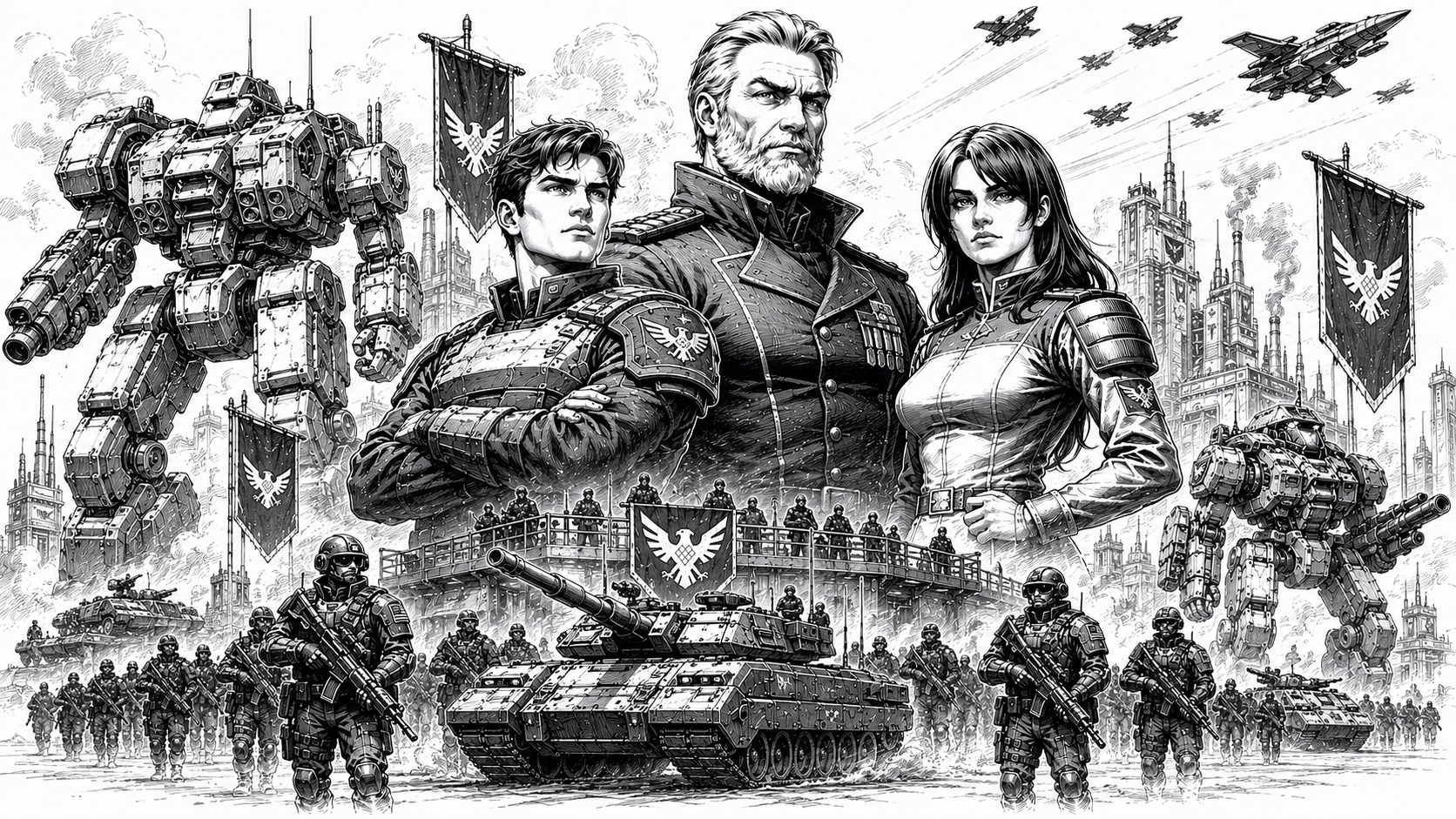 State propaganda illustration depicting Victor Hawkins (center) and his children, Maximus (left) and Ryder (right) Hawkins, standing before the military strength of the Confederate Vanguard Union. Images of this kind are commonly displayed throughout Confederate space to symbolize unity, strength, and reverence for House Hawkins.
Overview
| Government Type | Military State |
| Capital | Starhold |
| Leadership | Confederate Military Council |
| Population | 16.8 billion |
| Primary Strength | Industry and Mechanized Warfare |
| Military Specialty | Heavy Mech Assault |
| National Motto | “Forged From Victory.” |
The Confederate Vanguard Union, commonly referred to simply as the Union, is one of the five dominant powers of the Core Worlds.
The Union is widely regarded as the most militarized state in the Core and possesses the largest standing mech force among the Great Houses. Its society is heavily shaped by military service, industrial labor, and state-directed nationalism.
Union culture emphasizes strength, sacrifice, discipline, and collective identity above individual ambition. Service to the state is regarded not merely as duty, but as the foundation of civilization itself.
While critics often describe the Union as authoritarian and expansionist, supporters argue that the Confederates possess the resolve and industrial capacity necessary to preserve humanity against the growing instability of the frontier.
More than any other Great House, the Union derives its legitimacy from military victory. Unlike powers founded upon bloodlines, commerce, technology, or tradition, the Union was born from conquest and restoration. To Confederates, the state itself stands as proof that victory shapes history.
History
The origins of the Confederate Vanguard Union trace back to the collapse of the Old Empire and the dark age that followed. During the occupation of the Core by the Ophidian Supremacy, remnants of the Empire's Vanguard military forces escaped into exile, carrying with them the traditions, discipline, and organizational structure of the old regime.
For generations these exiled forces survived beyond the Core, preserving their military heritage while waiting for an opportunity to reclaim their homeland. That opportunity finally arrived during the Great Restoration, when the Vanguard returned and helped lead the campaigns that shattered the Ophidian occupation and restored human rule to the Core.
In recognition of their service, the newly established Star Regent granted vast territories to the victorious Vanguard armies. From these lands emerged the Confederate Vanguard Union.
This origin continues to shape Confederate identity. Unlike other powers that trace their legitimacy to ancient bloodlines, economic success, or political institutions, the Union traces its existence to a military victory. The state quite literally owes its existence to those who fought and won a war.
This belief lies at the heart of the Union's national philosophy. The Confederate motto, "Forged From Victory," is not merely a slogan. It is a statement of historical fact. To the Union, victory is not simply desirable—it is the force through which nations, civilizations, and destinies are created.
Starhold
Starhold is the capital world of the Confederate Vanguard Union and the beating heart of its military-industrial machine. Vast foundries, fortress-cities, mech assembly complexes, and orbital shipyards dominate much of the planet's landscape, producing the weapons, vehicles, and war machines that sustain the Union's military power.
The world itself is one of extremes. Its northern hemisphere is covered in frozen tundra and glacial plains, while much of the southern hemisphere consists of harsh deserts and rocky badlands. Despite these conditions, Starhold supports a massive population through extensive industrial infrastructure and carefully managed urban arcologies.
More than a capital, Starhold serves as a symbol of Confederate identity. It is home to the Confederate Military Council, the Honor Guard, numerous military academies, and some of the largest training facilities in the Core. To many Union citizens, Starhold represents the ideal toward which all Confederates should strive: strong, disciplined, productive, and prepared.
House Hawkins
The Confederate Vanguard Union is ruled by House Hawkins, a family whose history is inseparable from the military traditions of the Union itself. For generations, members of the house have served as officers, generals, commanders, and political leaders, helping shape the state into the most militarized power in the Core.
The current ruler, High Minister Victor Hawkins, is widely regarded as one of the most capable strategists in the Core. Quiet, calculating, and intensely disciplined, Victor is known for approaching both warfare and politics with the same deliberate mindset. Though a formidable warrior in his own right, his true strength lies in long-term planning and strategic maneuvering. Victor learned from an early age that battles are won not only on the battlefield but also through diplomacy, intelligence, economics, and political influence. Supporters view him as a harsh but fair leader whose foresight has strengthened the Union. Critics often regard him as manipulative and difficult to read. His involvement in supporting elements of the Free Suns Rebellion within the Imperium remains one of the most debated episodes of his career, with many believing he quietly sought to weaken a rival power without drawing the Union directly into conflict.
Despite his reputation for pragmatism, Victor possesses a deeply personal side rarely seen in public. His wife was widely regarded as the great love of his life, and following her death he never remarried nor took another lover. To many within the Union, this quiet loyalty stands in contrast to the ruthless image often projected by his political opponents.
Victor's designated heir is his daughter, Ryder Hawkins. A gifted mech pilot, accomplished battlefield commander, and natural warrior, Ryder embodies many of the qualities Confederate society admires most. She is fearless, charismatic, and possesses an instinctive understanding of combat that has earned her numerous victories. Yet Ryder's greatest strengths are also often viewed as her greatest weaknesses. Impulsive, hedonistic, and frequently dismissive of convention, she is notorious for drinking with enlisted soldiers, fraternizing with troops, and disregarding the social expectations normally associated with high-ranking nobility. Her aggressive tendencies extend to the battlefield, where she has occasionally taken risks that more cautious commanders consider reckless. While her skill has thus far allowed her to survive such decisions, many within the Union quietly question whether she possesses the discipline necessary to someday lead the state. Ryder herself is aware of her reputation and is known to joke that she has only ever been good at two things: fighting and fraternizing.
Her brother, Maximus Hawkins, presents a stark contrast. While not considered an exceptional mech pilot, Maximus is widely respected as a capable commander and dependable leader. Careful, measured, and deeply professional, he follows both military regulations and chains of command with a consistency that has earned the trust of his soldiers. Unlike his sister, Maximus has little personal ambition for higher office. He serves because he believes it is his duty, not because he seeks power. Many officers privately view him as the steadier of the two siblings, though even they acknowledge that he lacks Ryder's natural charisma and battlefield brilliance.
Together, Victor, Ryder, and Maximus represent three different expressions of the values that define the Union: strategic vision, martial excellence, and dutiful service. Throughout Confederate space, House Hawkins is often portrayed as the embodiment of Union ideals—strength, sacrifice, discipline, and an unwavering commitment to victory.
Government
The Union is governed through a centralized military-administrative system dominated by the Confederate Military Council. While House Hawkins occupies the highest position within the state, governance is distributed among senior military officers, industrial directors, regional governors, and state administrators.
Unlike many powers of the Core, the Union does not view military service solely as a means of national defense. It views service as one of the most effective ways to develop leadership, discipline, responsibility, and practical decision-making. As a result, veterans occupy many of the highest positions throughout Confederate society, and military experience is widely regarded as one of the strongest indicators of competence.
This belief extends beyond the armed forces themselves. Industrial managers, planetary governors, infrastructure planners, and political leaders often possess military backgrounds, creating a government culture that emphasizes organization, accountability, and results.
Supporters argue that this system produces leaders capable of making difficult decisions under pressure and prioritizing the needs of society above personal interests. Critics contend that it concentrates excessive power within military institutions and encourages a narrow view of governance.
The Union rejects such criticism. Confederate leaders maintain that civilization survives only because capable individuals are willing to accept responsibility for defending and managing it. To the Union, leadership is not a privilege—it is a duty earned through service.
Society and Culture
Confederate society is built upon the belief that civilization survives through strength, sacrifice, and collective effort. Military service is regarded as one of the highest callings available to a citizen, but soldiers are not the only figures celebrated within Union culture. Industrial workers, engineers, miners, logistics specialists, and manufacturers are all viewed as essential contributors to the state's success.
The Union places enormous emphasis on discipline, duty, and personal responsibility. Citizens are taught that rights are inseparable from obligations and that every individual owes a debt to the society that protects them. This philosophy has produced a population that is highly patriotic, intensely resilient, and often willing to accept sacrifices that citizens of other powers would consider unreasonable.
Public life is saturated with military symbolism and historical remembrance. Monuments, museums, military academies, and memorials can be found throughout Confederate territory. State media frequently celebrates military victories, industrial achievements, and examples of personal sacrifice in service to the Union.
Critics often describe Confederate society as authoritarian and excessively nationalistic. Confederate citizens generally respond that freedom without security is meaningless, and that the prosperity enjoyed throughout the Core was built by those willing to fight for it.
Military
The Confederate Vanguard Union fields the largest military force in the Core and is widely regarded as one of its most dangerous. Descended from the Vanguard armies that helped reclaim the Core during the Great Restoration, the Union continues to view military excellence as both a practical necessity and a defining element of national identity.
Unlike many rival powers that specialize in particular forms of warfare, the Union favors balanced and versatile forces capable of operating effectively under almost any battlefield conditions. Union mechs are rarely the fastest, the heaviest, or the most technologically advanced machines in the Core. Instead, they are designed to be dependable, durable, and effective across a wide range of combat scenarios.
Union engineers place particular emphasis on battlefield endurance. Advanced cooling systems allow Confederate mechs to sustain combat operations longer than many rival designs, while standardized components simplify maintenance and repair. Combined with the Union's immense industrial capacity and logistical expertise, this allows Confederate forces to maintain relentless battlefield pressure during extended campaigns.
The Union's true strength, however, lies in large-scale military coordination. Confederate commanders are renowned throughout the Core for their ability to manage complex operations involving thousands of mechs, vehicles, aircraft, and support personnel. Throughout the modern era, the Union has frequently been called upon to coordinate large-scale military operations for the Conclave, earning a reputation as the de facto generals of the Core.
Confederate doctrine favors decisive engagements, overwhelming force, and sustained offensive momentum. When the Union commits to war, it seeks victory through superior organization, logistics, and battlefield endurance rather than technological gimmicks or elaborate maneuvering.
The Battlestars
Battlestars are immense vessels are among the oldest and most valuable military assets still operating in human space, relics of earlier ages whose construction techniques have long since been lost.
Far more than simple warships, Battlestars function as self-contained military cities. Each carries vast populations of soldiers, technicians, industrial workers, support personnel, and civilians. They possess their own manufacturing facilities, food production systems, hospitals, command centers, and logistical infrastructure, allowing them to sustain military operations for extended periods far from friendly territory.
While most Great Houses possess only two operational Battlestars, the Union controls three: The Indomitable, The Wrath Bringer, and The Justice. Together, these colossal vessels can transport tens of thousands of personnel and thousands of mechs, giving the Union unmatched strategic mobility and force projection capabilities.
The Battlestars are deeply woven into Confederate identity. They are viewed not merely as military assets but as symbols of the Union's heritage as the descendants of the Vanguard armies that helped reclaim the Core. Their silhouettes appear throughout Confederate propaganda, military ceremonies, and public monuments as reminders of the sacrifices that forged the Union.
Many military historians argue that the Union's possession of three operational Battlestars remains one of the greatest strategic advantages enjoyed by any Great House in the modern era.
Frontier Policy
The Union maintains one of the most active military presences beyond the borders of the Core. Confederate leaders believe that threats ignored on the frontier inevitably become threats within civilized space, and therefore advocate confronting instability before it can spread.
This philosophy places Union forces at the forefront of anti-piracy campaigns, frontier security operations, territorial disputes, and military interventions throughout the outer regions of known space. Confederate commanders often argue that many of the dangers facing the Core are addressed only because the Union is willing to commit forces where others hesitate.
Critics frequently accuse the Union of using security concerns as a justification for expanding its influence. Confederate leaders counter that history repeatedly demonstrates the dangers of complacency. In their view, civilizations do not collapse because they confront threats too early. They collapse because they wait too long.
As a result, the Union often favors proactive action over cautious observation, a philosophy that has earned it both loyal allies and wary rivals throughout the Core.
Politics and Foreign Relations
The Union occupies a unique position within the Core. As the largest military power among the Great Houses and the direct successor to the Vanguard forces that reclaimed the Core during the Great Restoration, it views itself as both a guardian of civilization and the ultimate guarantor of regional stability.
Relations with the Helios Sovereignty are often tense. Union leaders frequently criticize the Sovereignty's aristocratic culture, political maneuvering, and concentration of wealth, viewing many of its elites as disconnected from the realities faced by ordinary citizens. The Sovereignty, in turn, often regards the Union as overly militaristic and prone to solving political problems through force. Despite these differences, the two powers remain important economic and political partners within the Conclave.
Relations with the Starcrest Protectorate fluctuate between mutual respect and rivalry. Both states value discipline, military service, and personal sacrifice, and their soldiers generally respect one another's capabilities. At the same time, competition for influence along shared frontier regions and differing approaches to governance occasionally place the two powers at odds.
The Union's relationship with Orion Corporate is defined by both cooperation and suspicion. Union leaders admire the Corporate's industrial output and technological achievements, yet remain wary of its growing influence over the Core's scientific, economic, and technological infrastructure. Many Confederates believe the Corporate places too much faith in technology and not enough in the people who ultimately wield it.
Relations with the Omnisphere Imperium are similarly complicated. Both powers possess proud military traditions and view themselves as heirs to humanity's greatest achievements. This shared self-confidence has historically produced both cooperation and rivalry, with neither state particularly eager to concede military prestige to the other.
Despite its fiercely independent character, the Union remains loyal to the Star Regent and the institutions of the Stellar Conclave. However, Confederate leaders have never been shy about voicing their disagreements with Regency policy, and many regard the Union as one of the few powers willing to openly challenge the Crown when they believe the security of the Core is at stake.
Mercenary Relations
The Union is one of the largest employers of mercenary companies in the Core and generally maintains positive relations with independent military contractors.
Mercenaries often find Confederate military culture highly competitive, but they are usually treated as valued auxiliaries rather than expendable outsiders. Union commanders respect competence and battlefield performance above nearly all other qualities, and successful mercenary units can earn considerable prestige through Confederate service.
While Union contracts rarely offer exceptional pay or salvage rights, they frequently provide outstanding logistical support. Mercenary companies operating alongside Confederate forces often receive access to transportation assets, repair facilities, supply networks, and deployment allowances unavailable elsewhere in the Core. As a result, contractors are frequently able to field larger and heavier forces than they could under similar contracts from rival powers.
Many mercenaries describe Union contracts as practical rather than lucrative. A company is unlikely to become wealthy serving the Confederates, but it will rarely find itself lacking ammunition, spare parts, or support.
As one common mercenary saying goes:
"The Union won't make you rich. It'll make sure you win."
The Vanguard Legacy
More than any other Great House, the Union defines itself through its history.
Confederates trace their origins to the Vanguard armies that survived exile, reclaimed the Core, and helped restore civilization following the Ophidian occupation. While centuries have passed since those events, their memory remains central to Confederate identity.
Throughout Union territory, monuments, museums, military academies, and public ceremonies commemorate the Vanguard and their sacrifices. Children are taught their history from an early age, and many citizens view themselves as inheritors of a legacy earned through blood and hardship.
To the Union, the Vanguard are not simply historical figures. They are proof that civilization survives only when ordinary men and women are willing to fight for it.
Modern Outlook
The Union believes that peace is preserved through strength, not goodwill. While many powers of the Core continue to enjoy centuries of relative stability, Confederate leaders increasingly warn that such stability should not be mistaken for permanence.
From the Union's perspective, the history of humanity is defined by cycles of conflict, collapse, and recovery. The lessons of the Collapse, the Ophidian occupation, and countless frontier wars all point toward the same conclusion: threats rarely announce themselves until it is too late to prepare for them.
As a result, the Union continues to expand its industrial capacity, modernize its armed forces, and strengthen its frontier defenses. Critics view these efforts as evidence of militarism and expansionist ambition. Confederate leaders counter that preparedness is not aggression, and that the cost of readiness is far lower than the cost of being caught unprepared.
Many within the Union believe another great crisis will eventually confront the Core. Whether that challenge emerges from the frontier, from within the Conclave, or from beyond known space matters little. In the Confederate view, civilization survives only when strong men and women are willing to defend it.
The Union's answer to an uncertain future is simple: when the next war comes, be ready to win.